The Pro-Rata Rule Explained: Why Your Backdoor Roth May Still Be Taxable
A Backdoor Roth can sound surprisingly simple:
Make a nondeductible contribution to a Traditional IRA.
Convert the money to a Roth IRA.
Since you've already paid tax on the contribution, the conversion should be tax-free.
Sometimes it can work almost that simply.
But if you already have pre-tax money sitting in an IRA, there is an important rule to understand first:
The Pro-Rata Rule.
Think of Your IRA as Coffee and Cream ☕
Here's my favorite way to explain it.
Imagine your pre-tax IRA money is coffee and your after-tax IRA contribution is cream.
Suppose you already have:
$93,000 of pre-tax IRA money
Then you make:
$7,000 of after-tax IRA contributions
Now you have a $100,000 mixture:
93% coffee + 7% cream
Once you've mixed the coffee and cream together, you can't pour out a cup and say:
“I only want the cream.”
That's essentially the effect of the Pro-Rata Rule.
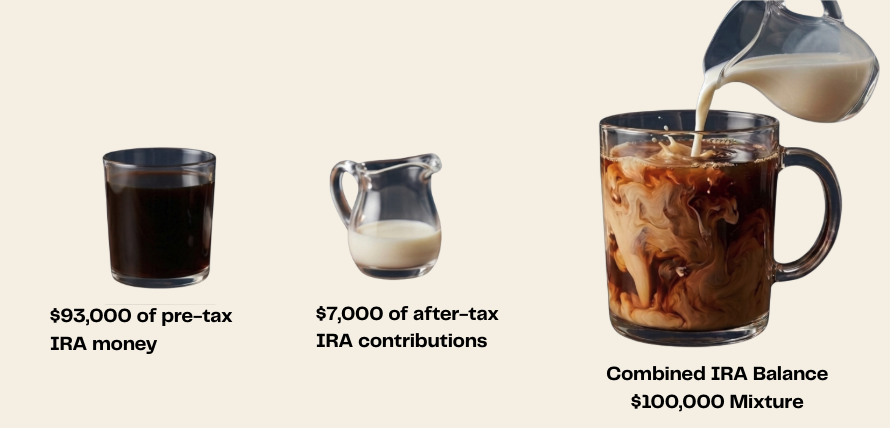
Coffee and cream analogy: once mixed, they can't be separated. Just like pre-tax and after-tax IRA dollars under the Pro-Rata Rule.
What Happens When You Convert $7,000?
In our example, only 7% of the combined IRA money represents after-tax basis.
If you convert $7,000 to a Roth IRA, you generally cannot simply designate that conversion as the $7,000 of after-tax money.
Instead, the taxable and non-taxable portions of the conversion are determined proportionally.
Using our simplified example:
7% × $7,000 = $490
Approximately $490 of the conversion would represent after-tax basis and therefore generally would not be taxed again.
The remaining:
$6,510
would generally be treated as taxable income from the conversion.
That's a very different result from assuming the entire $7,000 conversion would be tax-free.
“What If My IRAs Are at Different Brokerages?”
This is another common misunderstanding.
Suppose you have:
a Rollover IRA at Fidelity
a Traditional IRA at Schwab
a SEP IRA somewhere else
Keeping them at different financial institutions generally doesn't allow you to isolate one account for purposes of the Pro-Rata Rule.
The IRS generally looks across your applicable IRA balances collectively.
For this purpose, that generally includes:
Traditional IRAs
Rollover IRAs
SEP IRAs
SIMPLE IRAs
Think back to our coffee analogy:
Putting the coffee into three different cups doesn't turn any of it back into cream.
But Your 401(k) Is Different
This is where retirement-account location becomes important.
Assets held inside a qualified employer retirement plan such as a 401(k) generally are not included in the IRA aggregation used for the Pro-Rata calculation.
Consider someone who leaves an employer with a substantial pre-tax 401(k).
They may automatically think:
“I'll roll the whole thing into a Rollover IRA.”
That can be perfectly appropriate in some situations.
But once those pre-tax dollars move from the 401(k) into a Rollover IRA, they may become part of the IRA balance considered when calculating the taxable portion of a future Backdoor Roth conversion.
That's why a rollover decision shouldn't necessarily be made in isolation.
The question isn't only:
“Where do I want to invest this money?”
It can also be:
“How might moving this money affect the tax strategies I want available later?”
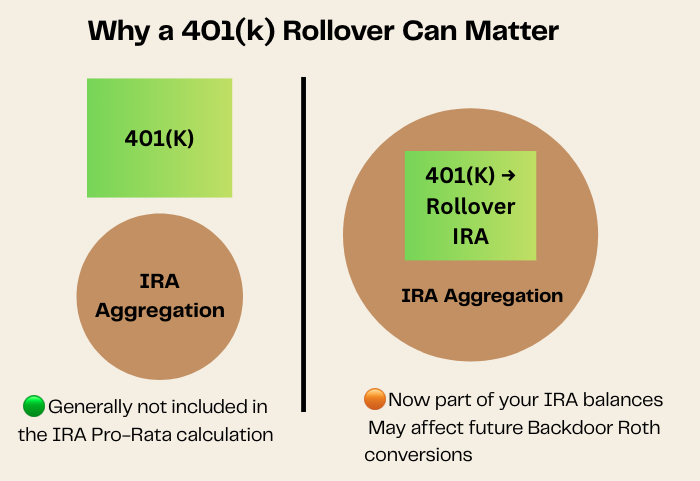
Illustration showing that 401(k) assets are generally outside IRA aggregation, while pre-tax assets rolled into a Rollover IRA become part of the IRA balances considered under the Pro-Rata Rule.
Backdoor Roth vs. Mega Backdoor Roth
These two strategies have similar names, but they are not the same thing.
A Backdoor Roth IRA generally involves making a nondeductible contribution to a Traditional IRA and subsequently converting it to a Roth IRA.
A Mega Backdoor Roth generally uses after-tax contributions inside an employer-sponsored retirement plan that permits the necessary contribution and Roth conversion or rollover features.
Because the Mega Backdoor Roth operates through an employer plan rather than using the same IRA contribution-and-conversion process, the mechanics are different.
The availability and specific rules depend on the employer's plan.
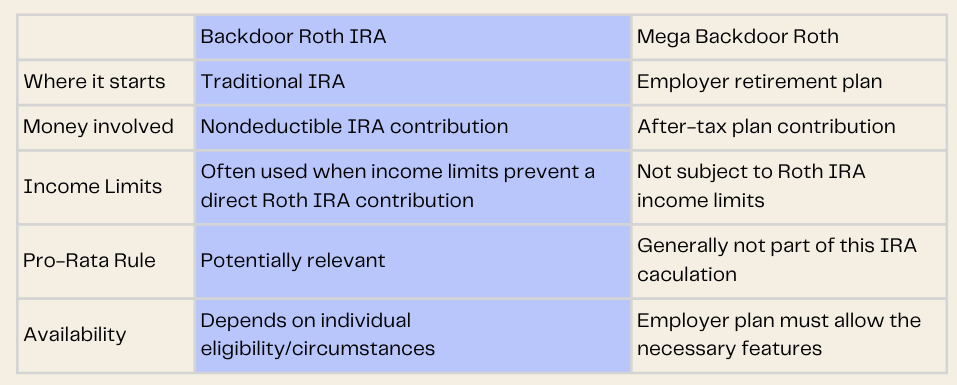
Comparison of Backdoor Roth IRA and Mega Backdoor Roth strategies, including account type, contributions, income limits, Pro-Rata Rule considerations, and availability.
One More Important Detail: December 31 Matters
The Pro-Rata calculation doesn't simply look at the IRA account from which you made the conversion.
The calculation takes into account your applicable IRA balances, including the value remaining in those IRAs at year-end as well as relevant distributions and conversions during the year. That's why your December 31 IRA balance can matter, even if you completed the Roth conversion months earlier.
The IRS uses Form 8606 to track nondeductible IRA basis and determine the taxable and non-taxable portions of certain IRA distributions and Roth conversions.
The Bigger Lesson
The Pro-Rata Rule isn't necessarily a reason to avoid a Backdoor Roth.
And it isn't necessarily a reason to avoid rolling a 401(k) into an IRA.
It simply illustrates something I think is important in retirement planning:
Financial decisions rarely exist in isolation.
A decision that looks convenient today can affect the options available tomorrow.
Before moving a large retirement balance or implementing a Roth strategy, look at the entire account structure first:
What pre-tax IRA balances already exist?
Are there after-tax IRA contributions?
Is a Backdoor Roth likely to be useful in future years?
What employer-plan options are available?
What are the investment, fee, distribution, and protection differences between the alternatives?
How does the decision fit into the broader retirement and tax plan?
Sometimes investment selection gets most of the attention.
But account structure - and where the money lives - can matter too.
Want to explore more?
I share practical education around retirement planning, 401(k)s, Roth strategies, retirement income, and building greater financial flexibility.
[Watch my related 401(k) rollover video]
This material is provided for general educational purposes only and is not intended as individualized investment, tax, or legal advice. Tax laws and retirement-plan provisions can change, and individual circumstances vary. Consult appropriate financial, tax, and legal professionals regarding your specific situation.
