What Does a 35% Annuity Bonus Really Mean?
A 35% annuity bonus sounds pretty attractive.
If you put in $100,000, does that mean you immediately have $135,000?
Not necessarily.
The key question is:
35% bonus to what?
Some fixed index annuities track two different values:
Accumulation Value
This is generally the value associated with your contract if you later take money out or surrender the contract, subject to the contract terms, withdrawal provisions, and any applicable charges.
Income Value
This is a separate value used to help calculate future lifetime withdrawals. Different insurance companies may use different names for this value.
These two numbers can be very different.
With some annuity designs, bonuses are credited to the income value, rather than to the accumulation value available for a lump-sum withdrawal. In the example structure used here, the income value is not itself available as a lump sum.
A Simple $100,000 Example
Suppose, for illustration, an annuity provides a 35% bonus to its income value.
You put in:
$100,000
The contract could initially show something like:
Accumulation Value: $100,000
Income Value: $135,000
That does not mean you earned $35,000 that you can immediately withdraw.
Instead, the $135,000 income value may be used later to be used to help calculate lifetime withdrawals.
The important distinction:
$135,000 income value ≠ $135,000 cash value
That is why looking at the bonus percentage by itself can be misleading.
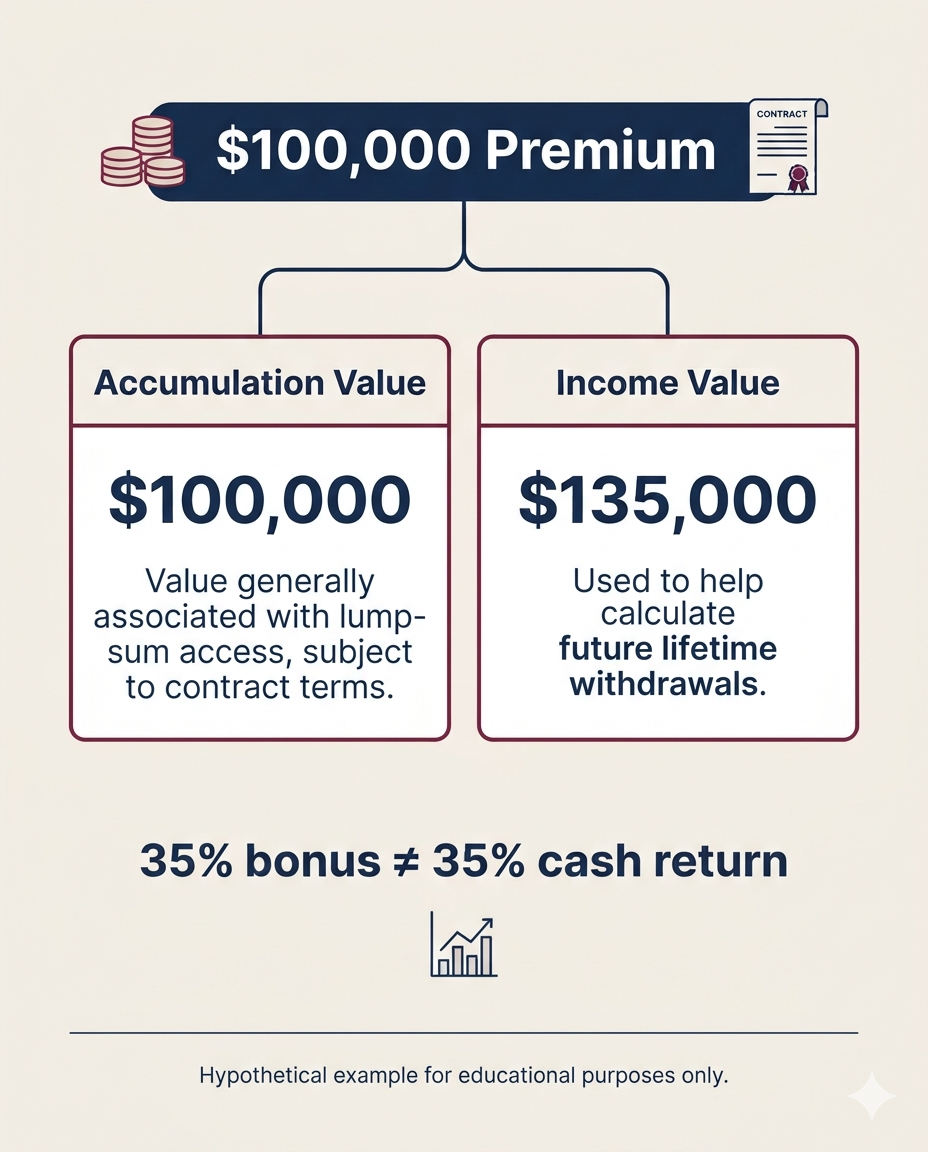
$100,000 annuity example comparing accumulation value and income value after a hypothetical 35% bonus.
What About a 250% Interest Bonus?
This number can sound even more dramatic.
But a 250% interest bonus does not mean a 250% investment return.
It may instead describe how an interest credit is applied when calculating the income value.
For example, suppose a hypothetical crediting strategy generates a 4% Interest credit.
Then:
4% × 250% = 10%
The income value could receive a 10% credit.
But the accumulation value may receive a different amount.
In the example structure illustrated here, a 250% income-value factor is paired with a 50% accumulation - value factor.
So a hypothetical 4% interest credit could mean:
Income Value credit: 10%
Accumulation Value credit: 2%
Again:
250% bonus ≠ 250% return on your money
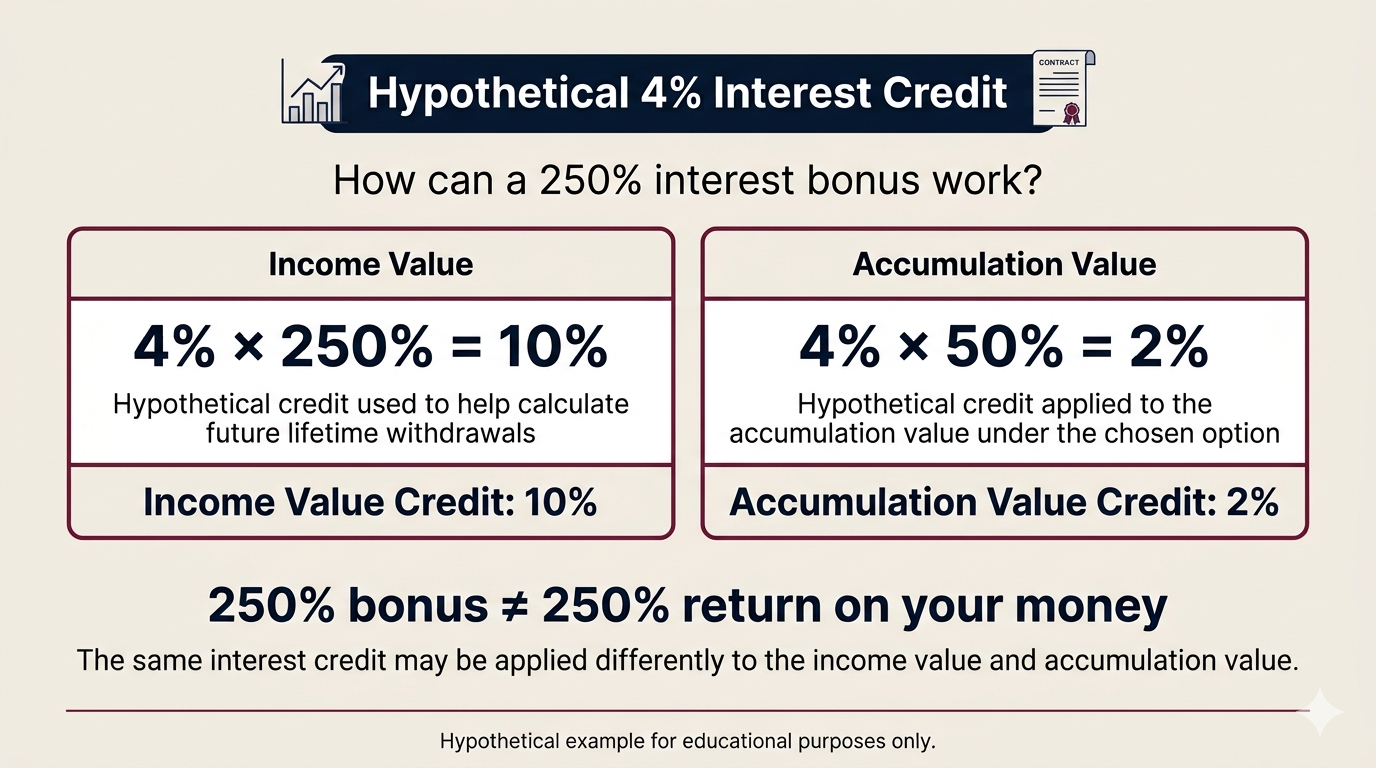
Example showing a 4% interest credit applied differently to income value and accumulation value.
Which Value Matters More?
That depends on what you want the money to do.
If your goal is primarily:
Growth and future lump-sum access
then the accumulation value, liquidity provisions, surrender period, and actual interest-crediting terms may matter more.
If your goal is:
Creating lifetime retirement income
then the income value and the amount of income it can ultimately generate may matter more.
Neither goal is automatically better.
They simply require looking at different parts of the contract.
Bigger Bonus Does Not Automatically Mean Better Income
A 35%, 40%, or even larger bonus may catch your attention.
But a larger bonus does not necessarily mean higher retirement income.
Actual lifetime income can depend on factors, including:
your age,
how much you contribute,
when you begin income,
how the income value grows,
the applicable payout percentage,
crediting methods and contract terms.
For example, some annuity designs use age-based withdrawal percentages when calculating lifetime withdrawals from the income value.
So instead of asking:
“Which annuity has the biggest bonus?”
A better question may be:
“What does the bonus actually increase, and how does that translate into future income?”
Before You Compare Annuity Bonuses
Look beyond the headline percentage and ask:
What value receives the bonus?
Can that value actually be withdrawn as a lump sum?
What happens if I need access to my money early?
How long is the withdrawal-charge period?
How is interest credited to the accumulation value?
How much lifetime income could the contract actually provide?
Bonus annuities may include higher withdrawal charges, longer withdrawal-charge periods, lower rates, or other restrictions that are not included in similar annuities without a bonus feature.
The Bottom Line
A large annuity bonus is not automatically good or bad.
What matters is understanding what the bonus actually applies to.
If the bonus increases an income value, it may help support future lifetime income.
But it does not necessarily mean your cash value increased by the same percentage.
So when you see a large annuity bonus, remember one simple question:
Bonus to what?
That question can make a complicated annuity much easier to understand.
Important Disclosure
This article is provided for general educational purposes only and is not intended as individualized investment, insurance, tax, or legal advice. It is not a recommendation or solicitation to purchase or sell any particular annuity or financial product.
The percentages and numerical examples shown are hypothetical illustrations designed to explain how certain annuity bonus structures may work. Product features, terminology, bonus percentages, interest-crediting methods, caps, participation rates, spreads, charges, withdrawal provisions, surrender periods, income features, and availability vary by insurance company, product, state, and broker/dealer.
An income value, income base, protected income value, or similar benefit value may be used solely to calculate future lifetime withdrawals and may not be available as a lump sum. Review the specific insurance contract and carrier materials for the terms applicable to a particular product.
Fixed index annuities are insurance contracts. They do not directly invest in an external market index. Interest credits may be based in part on the performance of an external index and are subject to the terms and limitations of the contract.
Withdrawals may reduce contract values and future income benefits and may be subject to ordinary income tax. Withdrawals before age 59½ may also be subject to an additional 10% federal tax.
Guarantees are subject to the financial strength and claims-paying ability of the issuing insurance company.
